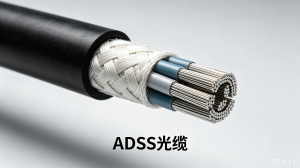
In the field of fiber optic communications, the ADSS Fiber Optic Cable (All-Dielectric Self-Supporting) has become the preferred choice for power lines and complex environments due to its unique metal-free design and self-supporting capability. As a professional Chinese fiber optic exporter, we understand the critical position of ADSS cables in the outdoor fiber optic cable market. This article delves into its structure, advantages, application scenarios, and compares it with traditional cables to help you make an informed decision.
ADSS (All-Dielectric Self-Supporting) cable is a type of optical cable made entirely of dielectric materials (such as aramid yarn and polyethylene sheaths) and contains no metallic components. Its self-supporting design allows it to be suspended between power towers or poles without the need for additional support structures. This cable is commonly used for communication transmission on high-voltage power lines because its all-dielectric特性 eliminates the risk of electromagnetic interference and lightning strikes.
The typical construction includes: a central loose tube (containing the fibers), an aramid yarn strength layer, and a weather-resistant outer sheath. It possesses high mechanical strength, capable of withstanding long-term wind and ice loads.
Since it contains no metal, the ADSS cable is completely绝缘 and does not induce current with power lines, nor does it require grounding. This makes it extremely safe for power communications, especially suitable for high-voltage environments.
Unlike ordinary cables that require steel wire for support, ADSS cables can be directly fixed to towers, simplifying the construction process. Their lightweight design reduces the load requirements on the towers.
Utilizing high-quality aramid yarn and outer sheaths, ADSS cables resist UV radiation, temperature fluctuations, wind, sand, and ice loads. Their tensile strength can typically reach tens of kilonewtons, ensuring long-term stable operation.
Beyond power communications, ADSS cables are also suitable for railways, highways, oil and gas pipelines, serving as an ideal outdoor fiber optic cable choice. For fiber optic cable projects requiring long spans and harsh environments, ADSS is a highly cost-effective solution.
| Feature | ADSS Cable | Standard Outdoor Cable (e.g., GYTA) |
|---|---|---|
| Metal Components | None (All-Dielectric) | Yes (Armor or strength member) |
| Self-Supporting Capability | Yes, direct suspension | No, requires auxiliary messenger wire |
| EMI Immunity | Excellent (Insulated) | Poor (Metal is susceptible) |
| Installation Complexity | Low | High (needs extra hardware) |
| Suitable Environment | High-voltage power lines, long spans | Standard ducts, aerial |
| Typical Lifespan | 25+ years | ~20 years |
Data Source: Fiber Optics for Sale – ADSS Cable Overview
Utility companies commonly use ADSS cables to build communication links alongside OPGW (Optical Ground Wire) for remote monitoring, SCADA, and smart grids. Their metal-free特性 avoids interference with power lines.
In complex terrains like mountains and rivers, ADSS cables can span hundreds of meters without intermediate supports. For example, an ADSS cable provided by a Chinese exporter for a project in Southeast Asia successfully spanned a 500-meter canyon.
Although ADSS is primarily used outdoors, combining it with indoor fiber (e.g., GJXH drop cables) allows for building a complete FTTx network. Outdoors, ADSS is terminated at the equipment room, where it connects to indoor cables via pigtails for seamless coverage.
ADSS cables hold an irreplaceable position in power communications and long-span aerial scenarios due to their all-dielectric, self-supporting, and highly weather-resistant advantages. As a professional Chinese fiber optic exporter, we recommend the following key points for selection:
For a customized fiber optic cable solution, please contact us for a professional quote.
OPGW (Optical Ground Wire) embeds fibers within a ground wire, combining lightning protection and communication, but contains metal and requires grounding. ADSS is fully绝缘 and more flexible to install, suitable for lines with an existing ground wire.
Generally, not recommended. ADSS is designed specifically for outdoor aerial use, featuring a thick sheath and lower flame retardancy. For indoor use, indoor fiber (e.g., GJXH or GJFJV) should be used, as it offers better flexibility and flame retardancy.
Based on transmission needs: 12 to 48 cores are common for general power communications. For redundancy or future expansion, 72 to 144 cores can be selected. Single-mode fiber (G.652D) is the most common choice.
我们将在24小时内回复您



Discussion
Share your thoughts or ask questions about this article