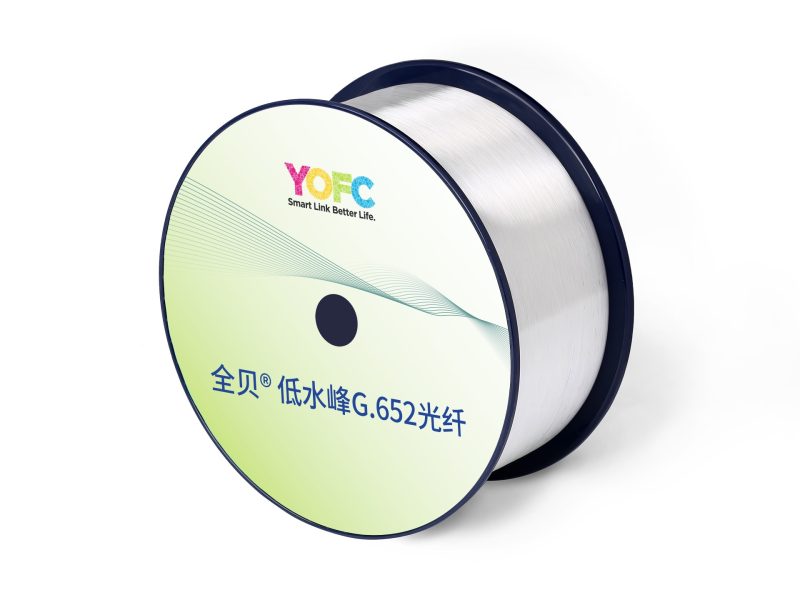
Low Water Peak Single-Mode Fiber: Full-Band Transmissio […]
In modern optical networks, bandwidth demand is growing exponentially. The Low Water Peak Single-Mode Fiber (also known as FullBand® fiber) eliminates the water peak at 1383 nm, unlocking the entire spectrum from 1260 nm to 1625 nm. This article explains why low water peak fiber is the best choice for backbone, metro, and access networks.
Traditional single-mode fibers suffer from high attenuation near the 1383 nm water peak. Our Low Water Peak Single-Mode Fiber reduces this attenuation dramatically, enabling full-spectrum transmission. This fiber complies with ITU-T G.652.D and IEC 60793-2-50 B1.3 standards.
Key standards:
ITU-T G.652.D compliant
IEC 60793-2-50 B1.3 compliant
Stricter internal tolerances for key parameters
The FullBand® fiber supports:
Ethernet
Internet Protocol (IP)
Asynchronous Transfer Mode (ATM)
Synchronous Optical Networking (SONET)
Wavelength Division Multiplexing (WDM)
It works perfectly for:
Backbone networks – long-haul transmission
Metro networks – city-wide connectivity
Access networks – FTTH and last-mile delivery
The fiber is compatible with:
Fiber ribbon cables
Loose tube stranded cables
Skeleton cables
Central tube cables
Tight-buffered cables
| Feature | Benefit |
|---|---|
| 1260–1625 nm full-band transmission | 50% more spectral bandwidth → higher system capacity |
| Excellent optical characteristics | Supports high-speed DWDM and CWDM |
| Compatible with 1310 nm equipment | Smooth migration from legacy networks |
| Superior coating protection | Easy stripping, high durability |
| Precise geometry | Low splice loss, high splicing efficiency |
DWDM and CWDM systems need consistent low attenuation across a wide wavelength range. Standard fibers block the water peak band (around 1383 nm), wasting valuable spectrum. With low water peak fiber, you gain:
More DWDM channels
Longer unrepeated spans
Future-proof infrastructure
| Parameter | Value |
|---|---|
| Wavelength range | 1260 nm – 1625 nm |
| Attenuation at 1383 nm | < ITU-T G.652.D limit |
| Core geometry | Precision-controlled |
| Cladding diameter | 125.0 ± 0.7 μm |
| Coating diameter | 245 ± 10 μm |
| Macrobend loss (1625 nm) | ≤ 0.1 dB (R30 mm, 10 turns) |
The Low Water Peak Single-Mode Fiber (FullBand®) delivers:
Full 1260–1625 nm transmission
50% more spectral bandwidth
Backward compatibility with 1310 nm systems
Compliance with ITU-T G.652.D and IEC B1.3
For network operators planning DWDM, CWDM, or high-capacity metro/core networks, this fiber is the optimal choice.
Q: What is the water peak in optical fiber?
A: The water peak is a high attenuation region near 1383 nm caused by OH⁻ ions. Low water peak fiber reduces this.
Q: Is this fiber compatible with existing G.652 fibers?
A: Yes, it fully complies with G.652.D and is splice-compatible with standard single-mode fibers.
Q: Can I use it for both CWDM and DWDM?
A: Yes, its wide low-loss window is ideal for both coarse and dense wavelength division multiplexing.
| 特性 | 条件 | 数据 | 单位 | |
|---|---|---|---|---|
| 光学特性 | ||||
|
衰减 |
1310nm | ≤0.34 | [dB/km] | |
| 1383nm(氢老化后) | ≤0.34 | [dB/km] | ||
| 1550nm | ≤0.20 | [dB/km] | ||
| 1625nm | ≤0.24 | [dB/km] | ||
| 相对于波长的衰减变化 | 1285-1330nm, 相对于1310nm | ≤0.03 | [dB/km] | |
| 1525-1575nm, 相对于1550nm | ≤0.02 | [dB/km] | ||
| 波长范围内的色散 | 1285-1340nm | -3.5到3.5 | [ps/(nm·km)] | |
| 1550nm | ≤18 | [ps/(nm·km)] | ||
| 1625nm | ≤22 | [ps/(nm·km)] | ||
| 零色散波长(λ0) | — | 1300~1324 | [nm] | |
| 零色散斜率(S0) | — | ≤0.092 | [ps/(nm2·km)] | |
| 零色散斜率典型值 | — | 0.086 | [ps/(nm2·km] | |
| 偏振模色散系数(PMD) | 单根光纤最大值 | — | ≤0.1 | [ps/√km] |
| 光纤链路值(M=20,Q=0.01%) | — | ≤0.06 | [ps/√km] | |
| 典型值 | — | 0.04 | [ps/√km] | |
| 光缆截止波长( λcc) | — | ≤1260 | [nm] | |
| 模场直径(MFD) | 1310nm | 8.7~9.5 | [μm] | |
| 1550nm | 9.8~10.8 | [μm] | ||
| 有效群折射率(Neff) | 1310nm | 1.466 | — | |
| 1550nm | 1.467 | — | ||
| 点不连续性 | 1310nm | ≤0.05 | [dB] | |
| 1550nm | ≤0.05 | [dB] | ||
| 几何特性 | ||||
| 包层直径 | — | 125.0±0.7 | [μm] | |
| 包层不圆度 | — | ≤1.0 | [%] | |
| 涂层直径 | — | 235~250 | [μm] | |
| 涂层/包层同心度误差 | — | ≤12.0 | [μm] | |
| 涂层不圆度 | — | ≤6.0 | [%] | |
| 芯/包层同心度误差 | — | ≤0.6 | [μm] | |
| 翘曲度(半径) | — | ≥4 | [m] | |
| 交货长度 | — | 最长50.4 | [km/盘] | |
| 环境特性 1310nm, 1550nm 和 1625nm | ||||
| 温度附加衰减 | -60℃ 到85℃ | ≤0.05 | [dB/km] | |
| 温度-湿度循环附加衰减 | -10℃ 到85℃,98% 相对湿度 | ≤0.05 | [dB/km] | |
| 浸水附加衰减 | 23℃, 30 天 | ≤0.05 | [dB/km] | |
| 湿热附加衰减 | 85℃,85%相对湿度,30天 | ≤0.05 | [dB/km] | |
| 干热老化 | 85℃,30天 | ≤0.05 | [dB/km] | |
| 机械特性 | ||||
| 筛选张力 | — | ≥9.0 | [N] | |
| — | ≥1.0 | [%] | ||
| — | ≥100 | [kpsi] | ||
| 宏弯附加损耗 | 100圈,半径30mm | 1625nm | ≤0.05 | [dB] |
| 100圈,半径25mm | 1310nm 和1550nm | ≤0.05 | [dB] | |
| 1圈,半径16mm | 1550nm | ≤0.05 | [dB] | |
| 涂层剥离力 | 典型平均值 | 1.5 | [N] | |
| 峰值 | 1.3~8.9 | [N] | ||
| 动态疲劳参数(nd) | — | ≥20 | ||
我们将在24小时内回复您