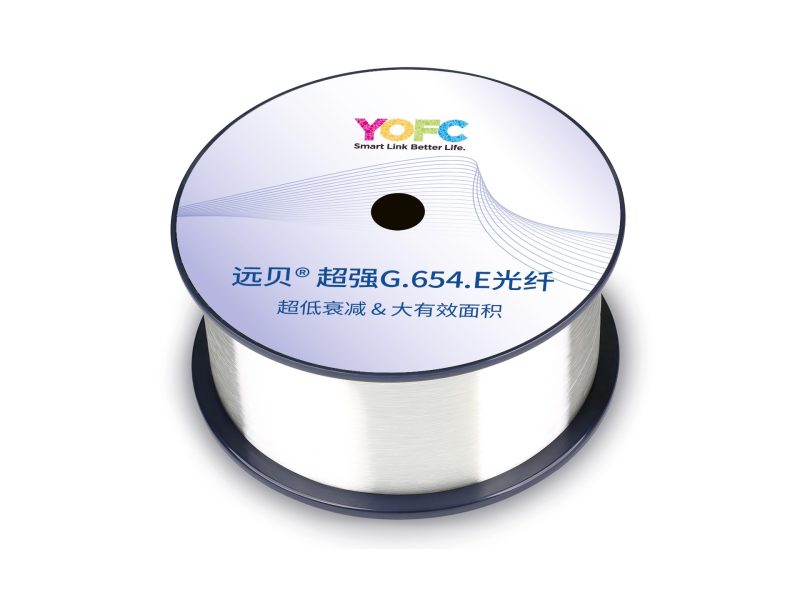
Ultra-Low Attenuation Large Effective Area Fiber: Maxim […]
For long-haul and high-speed optical networks, two parameters dominate system performance: attenuation coefficient and effective area (Aeff). The Ultra-Low Attenuation Large Effective Area Fiber (Yangtze Optical Fibre and Cable’s UltraBend® series) optimizes both, delivering superior Figure of Merit (FOM) for next-generation transmission systems.
Large effective area fiber reduces non-linear effects by increasing the core area where light travels. This allows higher signal power without distortion. When combined with ultra-low attenuation, the fiber enables longer repeater spans, fewer amplifiers, and lower CAPEX/OPEX.
This fiber complies with or exceeds industry standards for G.654 compatible categories, balancing large Aeff with macrobending resistance and hydrogen resistance.
According to the OSNR (Optical Signal-to-Noise Ratio) formula:
OSNR = 58 + Pout - NF - 10×log(N) - Att - 10×log(Aeff)
Lower attenuation coefficient and larger effective area directly improve OSNR. The industry uses Figure of Merit (FOM) to quantify this contribution:
FOM = (Aeff) / (attenuation coefficient)
A higher FOM means better system performance. As shown in the comparison below, the Ultra-Strength Fiber (UltraBend®) outperforms both standard ultra-low attenuation fiber and low-attenuation large-effective-area fiber.
| Fiber Type | Effective Area (µm²) | Attenuation (dB/km) | FOM (Aeff / α) | Relative Performance |
|---|---|---|---|---|
| Standard Ultra-Low Attenuation Fiber | ~80-100 | ~0.165 | ~500-600 | Baseline |
| Low-Attenuation Large-Aeff Fiber | ~110-120 | ~0.170 | ~650-700 | +15% |
| Ultra-Strength Ultra-Low Attenuation Large Aeff Fiber | 130-150 | 0.158-0.162 | 800-950 | +40 to +60% |
Modern systems require higher launch power to extend distances. However, non-linear penalties increase with power. By increasing effective area, this fiber delays non-linear onset. By lowering attenuation, it maximizes the signal reaching the receiver. The combination yields the best system reach per amplifier span.
FOM (Figure of Merit) = Effective Area (Aeff) / Attenuation Coefficient (α). Higher is better for long-haul systems.
Yes, it is designed for hybrid networks and splices compatibly with standard single-mode fibers while offering superior performance in long spans.
Yes. Fewer amplifiers and repeaters directly reduce both CAPEX (equipment) and OPEX (power, maintenance).
Conclusion: The Ultra-Low Attenuation Large Effective Area Fiber delivers industry-leading FOM, enabling longer spans, higher power, and lower total cost of ownership for backbone, submarine, and high-speed metro networks.
| Characteristics | Condition | Data | Unit |
|---|---|---|---|
| Optical Characteristics | |||
| Effective Area Typical Value | 1550nm | 110 | 125 |
| Mode Field Diameter | 1550nm | 11.4~12.2 | 12.0~13.0 |
| Attenuation | 1550nm | ≤0.17 | |
| 1625nm | ≤0.20 | [dB/km] | |
| Attenuation Variation with Wavelength | 1525~1575nm, relative to 1550nm | ≤0.02 | |
| 1550~1625nm, relative to 1550nm | ≤0.03 | [dB/km] | |
| Chromatic Dispersion Coefficient | 1550nm | ≤23 | |
| 1625nm | ≤27 | [ps/nm·km] | |
| Dispersion Slope | 1550nm | 0.050~0.070 | |
| Polarization Mode Dispersion (PMD) | Maximum single fiber | — | ≤0.1 |
| Fiber link value (M=20, Q=0.01%) | — | ≤0.06 | [ps/√km] |
| Typical value | — | 0.04 | [ps/√km] |
| Cable Cutoff Wavelength (λcc) | — | ≤1520 | |
| Effective Group Refractive Index | 1550nm | 1.463 | 1.465 |
| Point Discontinuity | 1550nm | ≤0.05 | |
| Geometric Characteristics | |||
| Cladding Diameter | — | 125.0±1.0 | |
| Cladding Non-Circularity | — | ≤1.0 | |
| Coating Diameter | — | 235~255 | |
| Coating/Cladding Concentricity Error | — | ≤12 | |
| Coating Non-Circularity | — | ≤6 | |
| Core/Cladding Concentricity Error | — | ≤0.6 | |
| Curl (Radius) | — | ≥4 | |
| Delivery Length¹ | — | Max. 25.2 | |
| Environmental Characteristics (1550nm and 1625nm) | |||
| Temperature Additional Attenuation | -60℃ to 85℃ | ≤0.05 | |
| Temperature-Humidity Cycling Additional Attenuation | -10℃ to 85℃, 98% RH | ≤0.05 | |
| Water Immersion Additional Attenuation | 23℃, 30 days | ≤0.05 | |
| Damp Heat Additional Attenuation | 85℃, 85% RH, 30 days | ≤0.05 | |
| Dry Heat Aging | 85℃, 30 days | ≤0.05 | |
| Mechanical Characteristics | |||
| Screening Tension² | — | ≥9.0 | |
| — | ≥1.0 | [%] | |
| — | ≥100 | [kpsi] | |
| Macrobend Additional Loss | 100 turns, radius 30mm | 1550nm | ≤0.10 |
| 1625nm | ≤0.10 | [dB] | |
| Coating Strip Force | Typical average | 1.5 | |
| Peak | 1.3~8.9 | [N] | |
| Dynamic Fatigue Parameter (nd) | — | ≥20 |
我们将在24小时内回复您